The Fisher Center is a premier professional performing arts center and a hub for research and education that demonstrates Bard College’s commitment to the performing arts as a cultural and educational necessity. To support artists, students, and audiences in the examination of artistic ideas, the Fisher Center develops, produces, and presents performing arts across disciplines through new productions and context-rich programs that challenge and inspire.
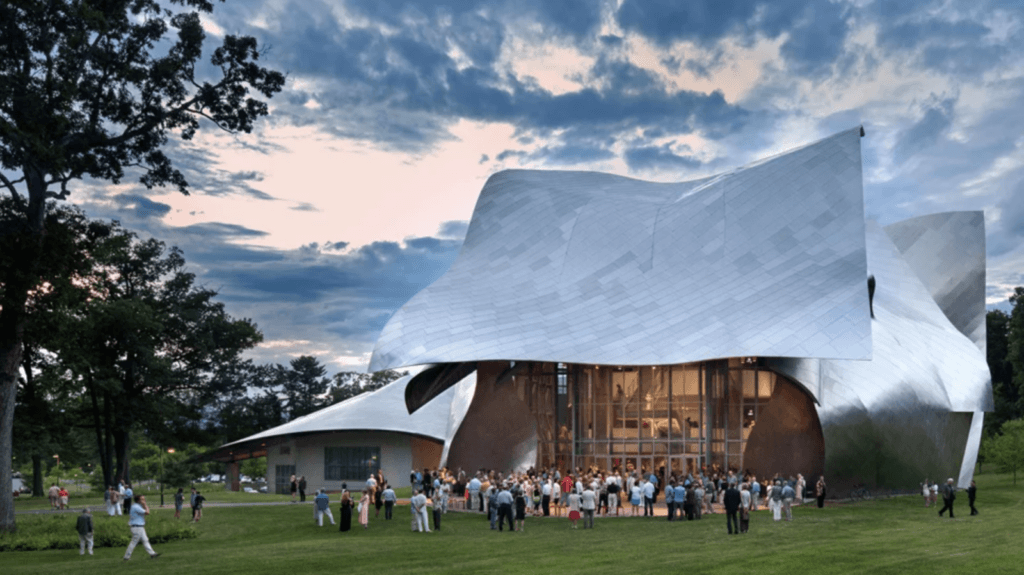
Home is the Fisher Center for the Performing Arts, designed by Frank Gehry and located on the campus of Bard College in New York’s Hudson Valley. This world-class theater building will be complemented by a new studio building designed by Maya Lin, scheduled to open in 2026. More than 200 events and 50,000 visitors are hosted at the Fisher Center each year, and over 300 professional artists are employed annually. As a powerful catalyst of art-making regionally, nationally, and worldwide, the Fisher Center produces 8 to 10 major new works in various disciplines every year. The Fisher Center offers outstanding programs to many communities, including the students and faculty of Bard College, and audiences in the Hudson Valley, New York City, across the country, and around the world. Building on a 166-year history as a competitive and innovative undergraduate institution, Bard is committed to enriching culture, public life, and democratic discourse by training tomorrow’s thought leaders.
The Fisher Center was born from the Bard Music Festival, founded in 1990, which, for the first 13 years of its existence, occupied several spaces on campus, including a large tent. Each summer, the Music Festival focuses on the life, work, and influences of one composer, promoting new ways of understanding and presenting the history of music to a contemporary audience. When the Fisher Center and its two theaters opened in 2003, the summer festival expanded to include a fully staged opera, as well as theater and dance performances. The highly acclaimed opera program brings unjustly neglected works to the stage in major productions—often making their U.S. debuts.
Through Fisher Center LAB, the Center’s acclaimed residency and commissioning program, artists are provided with custom-made support toward their innovative projects, and their work has been seen in over 100 communities around the world. Resident choreographer Pam Tanowitz’s 2018 Four Quartets was recognized as “the greatest creation of dance theater so far this century” by The New York Times. In 2019, the Fisher Center won the Tony Award for Best Revival of a Musical for Daniel Fish’s production of Oklahoma!, which began life in 2007 as an undergraduate production at Bard and was produced professionally by the Fisher Center in 2015 before transferring to New York City. Illinoise, a 2023 Fisher Center world premiere from artists Sufjan Stevens, Justin Peck, and Jackie Sibblies Drury, was recognized with a Tony Award for Best Choreography following its tour and transfer to Broadway.
The Fisher Center is home to several of Bard’s academic programs in the performing arts. Year-round, it hosts performances by the undergraduate Dance Program and Theater and Performance Program; the US-China Music Institute of the Bard College Conservatory of Music; The Orchestra Now (TŌN), a Bard graduate program that is training the next generation of classical-music ambassadors; and students at the Bard Conservatory, the first (and so far only) conservatory to require all its students to pursue a bachelor of arts degree in a field other than music in addition to their specialized music studies. As a hybrid institution, the Fisher Center brings together professional and academic art-making of the highest caliber, where student and professional artists work side by side, learning from each other and informing one another’s practices.
Mission
• Bring leading artists to the Hudson Valley to engage with the public and the College.
• Produce and present adventurous and in-depth programs, including new, rare, and undiscovered works.
• Support the development of new work by artists at all stages of their careers.
• Provide a home for Bard student and faculty work in the performing arts.
ACKNOWLEDGEMENT
We at the Fisher Center support, produce, and present the work of visionary, courageous, and unconventional artists—art that challenges and inspires—working to more prominently center marginalized peoples both onstage and off. The well-being of and care for our community, particularly those most vulnerable to systemic inequity, will be embraced as a central tenet of our organization.
We dedicate ourselves to pursuing an anti-racist future across our practices and programming. This is a continuous examination of our culture and processes, beginning with articulating the values we hold and why we hold them.
We recognize that we occupy the ancestral homelands of the Munsee and Muhheaconneok people and uphold ourselves to the values expressed in Bard’s Land Acknowledgement.
We acknowledge the systemic biases deeply embedded in our work, American culture, and society at large. At present, the Fisher Center is a predominantly white institution (PWI). Our staff, leadership, and artists are primarily white. We have often centered histories and voices representative of a primarily white, European, cismale perspective.
With this in mind, the Fisher Center is currently undergoing an organization-wide evolution towards an anti-racist, anti-hatred, anti-oppressive institution. We commit to creating an inclusive, equitable, and respectful environment for all who work, study, create, and engage in and with our programs.
Read Bard’s Land AcknowledgementVALUES
Exploration & Learning
We are a center for artistic research. We support artists whose practices center inquiry, experimentation, new ideas, complexity, thorough investigation of the past, and deep thought. We support artists whose work extends what is possible in the arts. We invest in ideas and artistic journeys without always knowing what the outcome will be. We delight in the unpredictable and share that delight with our audiences, within and far beyond the Fisher Center. We use our knowledge of the artists and projects we support to provide a rich context in which students and audiences can experience them.
Transparency & Intentionality
We invite constructive feedback and are prepared to listen, respond, and change.
We strive to create a welcoming, approachable, and hospitable community for all who participate in our mission. The integrity of our work and our culture is paramount. All are welcome and have the right to examine and question our operations, history, and future goals.
Community & Contribution
We work for and amongst many communities, including the students, faculty, and staff of Bard College, audiences and artists in our region and well beyond, as well as people traditionally excluded from the performing arts.
We are mindful and intentional about our relationship with each of these communities. Our relationship serves to; contribute value and meaning wherever we can; be conscientious colleagues and partners; and create an environment where conversation, insight, and introspection are exchanged.
Community Commitments
We strive to uphold the values expressed in our Community Commitments and ask audience members, visitors, and guests of the Fisher Center to nurture these values as well. Before visiting, please read our guidelines.
Professional Memberships
The Fisher Center at Bard is a Professional Company Member of Opera America.